
Your car absorbers have very little to do with ride comfort. They have everything to do with how quickly your car stops. When a shock absorber wears out, your tyres lose consistent road contact, braking distances increase, and handling becomes unpredictable. The part most drivers treat as a ride quality issue is one of the more consequential safety components on your vehicle. Here is what you need to know before you book a workshop.
Car Shock Absorber Services
What Is a Shock Absorber?
A shock absorber is the core component in your car’s suspension system in Malaysia, controlling how your wheels respond to bumps, potholes, and uneven road surfaces. It works alongside the springs to absorb impact energy, converting it into heat and dispersing it, keeping your tires in contact with the road and your ride stable and predictable.
Without functioning shock absorbers, your car would bounce continuously after every bump, braking distances would increase, and tyre wear would become uneven. It is a safety-critical component, not just a comfort one.
The 4 Types of Car Absorbers: Which One Does Your Car Have?
Whether you searched “car absorber”, “absorber kereta”, or “air suspension” the answer depends on which system your car actually has. That is completely normal. The type fitted to your car is set by the manufacturer, and most drivers have never needed to know the difference.
Here is a plain-language breakdown of the 4 categories:
Hydraulic and Gas Shock Absorbers
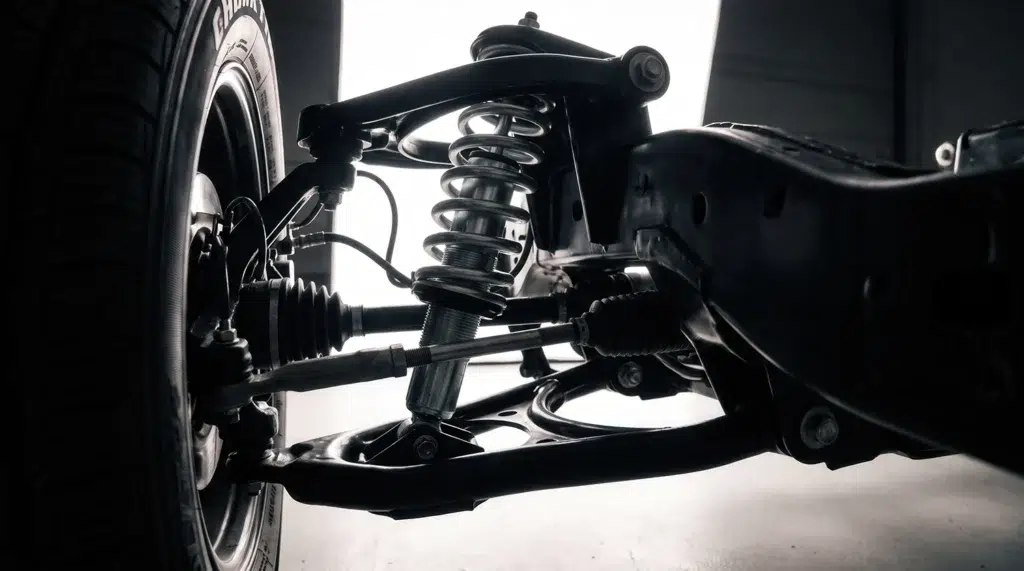
The standard type found in most everyday cars: Perodua Myvi, Toyota Vios, Honda City, Proton Saga, and similar. These are mechanical units: a cylinder filled with hydraulic oil (or oil and pressurised nitrogen gas) with a piston that resists movement. Gas-charged versions perform more consistently under heat and heavy use than pure oil units, but both fall into the same category for most practical purposes. No electronics are involved.
- Fitted To: Most passenger cars and non-luxury sport utility vehicles (SUVs).
- Characteristics: Mechanical operation, reliable performance, cost-effective to repair and replace.
- Common Signs of Wear: Bouncy ride, knocking from suspension, nose-diving under braking.
Air Suspension
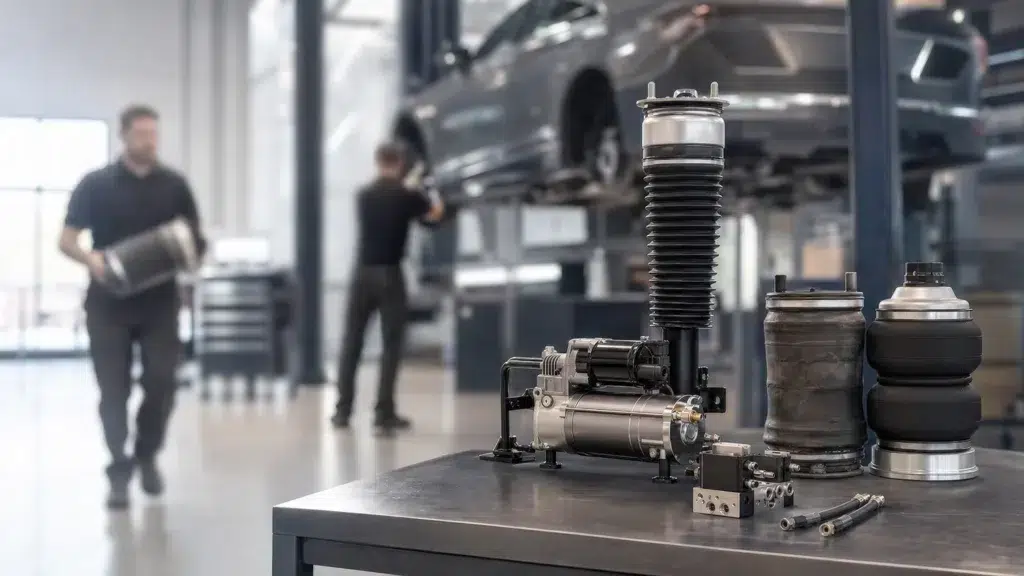
Instead of a coil spring and hydraulic damper, air suspension uses inflatable air springs (also called air bags or air struts) to support the vehicle. The ride height can be adjusted, either manually or automatically, and the ride tends to be noticeably softer than a standard setup. Air suspension is common on European marques and higher-spec SUVs.
- Fitted To: Mercedes-Benz, BMW, Audi, Land Rover, Volvo, and similar.
- Characteristics: Adjustable ride height, softer and more compliant ride, no electronic components.
- Common Signs of Wear: Vehicle sitting lower on one side, compressor running constantly, warning light on dashboard.
Electronic/Adaptive Dampers
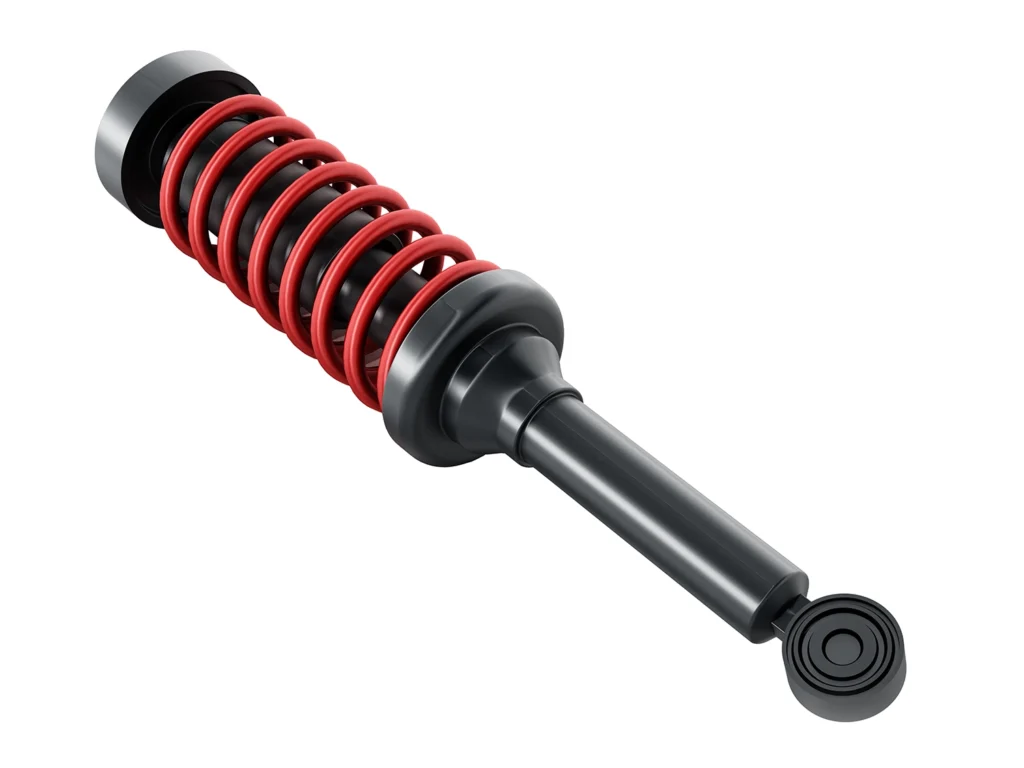
These use the same hydraulic base as standard shock absorbers, but the stiffness of each damper is adjusted electronically by the vehicle’s control system. Sensors monitor speed, steering input, and road conditions, and the system switches between comfort and sport settings in real time. This type is found on higher-specification performance and luxury models.
- Fitted To: BMW M models, Mercedes-Benz Aufrecht Melcher Großaspach (AMG) variants, Audi S and RS models, and similar.
- Characteristics: Real-time damping adjustment, selectable comfort and sport modes, sensor-controlled stiffness.
- Common Signs of Wear: Loss of adaptive response, ride becoming inconsistent between modes.
Electronic Air Suspension
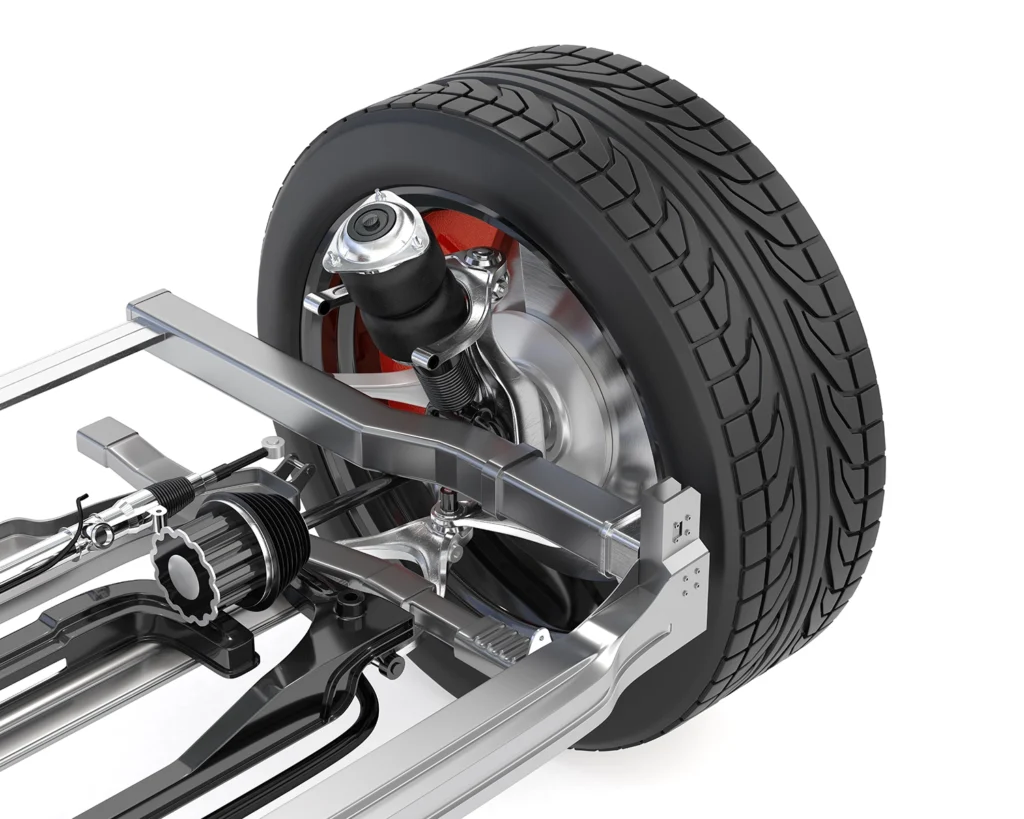
The most complex and highest-priced category: air springs combined with electronically controlled damping. The vehicle adjusts both ride height and damping stiffness automatically. This system is found on top-end SUVs and luxury sedans where maximum ride quality and handling adaptability are both required.
- Fitted To: Mercedes-Benz S-Class, BMW 7 Series, Range Rover, Porsche Cayenne, and similar.
- Characteristics: Fully adaptive ride height and damping, highest repair complexity, highest replacement cost.
- Common Signs of Wear: Same as air suspension, plus loss of drive mode response.
Signs Your Shock Absorber Needs Replacing
Whichever type your car uses, the warning signs of wear tend to follow a similar pattern. Your shock absorbers rarely fail all at once. These are the signs that something needs attention:
| Sign | What to look or listen for |
|---|---|
| Bouncy ride | The car keeps moving up and down after a bump instead of settling quickly. |
| Nose-diving under braking | The front of the car dips sharply when you apply the brakes. |
| Body roll in corners | The car leans more than usual when turning. |
| Uneven tyre wear | Scalloping or cupping patterns on the tyre tread. |
| Longer stopping distances | It takes more distance than usual to come to a full stop. Stopping distances can increase by up to 40% on worn shock absorbers. |
| Knocking or clunking | Noise from the suspension area over bumps or during cornering. |
| Vehicle sitting unevenly | One corner is lower than the others, particularly common with air suspension. |
If more than one of these applies to your car, it is worth getting a diagnosis first, as the price of car absorbers varies significantly depending on which type your vehicle uses.
Shock Absorber Price in Malaysia: What Affects the Cost
The price of a shock absorber for a car in Malaysia depends primarily on which of the 3 types your vehicle uses, its make and model, and whether parts or labour account for the larger share of the job.
The table below gives a relative sense of cost by category.
| Absorber type | Relative cost | Indicative Range |
|---|---|---|
| Hydraulic/gas | Lowest | From RM250 per unit |
| Electronic/ adaptive | Moderate to high | From RM600 per unit |
| Air suspension | High | From RM1200 per unit |
For an accurate quote based on your vehicle’s make, model and absorber type, contact the workshop directly.
Authorised Boashutein Installer
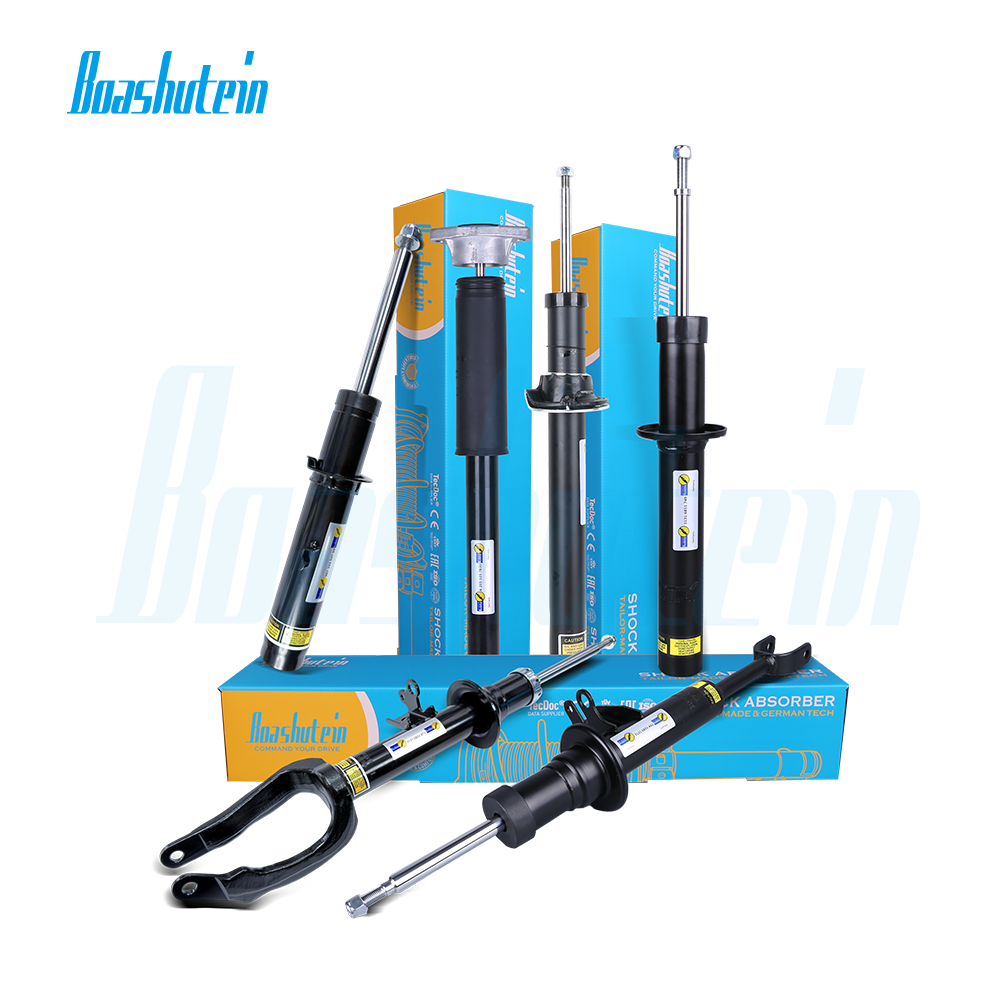
Sun Eng Hup is an authorised Boashutein shock absorber installer. Boashutein is based in Guangzhou, China, specialising in air suspension systems, electronic shock absorbers, air springs, and compressors for European and premium vehicles. The authorised installer scope covers [TYPE/S – to be confirmed by client]. Hydraulic and gas units are also serviced under Sun Eng Hup’s general workshop capability.
As an authorised installer, we follow the appropriate installation procedures for your vehicle’s suspension system. This includes correct component fitment and torque settings. System calibration is also carried out where required.
Proper installation is especially important for air suspension and electronically controlled systems. Incorrect fitment or calibration can affect ride quality, handling, and overall system performance.
Sun Eng Hup has been servicing European, Japanese, Korean, and national vehicles since 1991. Before ordering any suspension component, we inspect and diagnose the vehicle to identify the correct suspension type and compatible replacement parts.

Brands and Vehicles We Service

Sun Eng Hup services a wide range of European, Japanese, Korean and National vehicles, including the brands shown below.
European car
Book an Inspection
Bring your car in for an inspection and we will assess your suspension system, explain what needs attention, and recommend the appropriate repair or replacement option. There is no obligation to proceed.
Frequently Asked Questions
The questions below cover what most customers ask before booking.
What is the difference between air suspension and a normal shock absorber?
The main difference is that air suspension in Malaysia typically replaces the coil spring with an inflatable air bag, making ride height adjustable. A standard shock absorber uses a hydraulic cylinder and coil spring with no height adjustment. Air suspension tends to be softer and more adjustable, but it is more complex and more expensive to repair when components fail.
How do I know which type of shock absorber my car has?
The most reliable way is to check your vehicle’s specification sheet or owner’s manual. As a general rule: if your car has a ride height adjustment button or a suspension setting in the drive modes menu, it is likely fitted with air or electronic suspension. If it has none of these, it is most likely a standard hydraulic or gas setup. When in doubt, the workshop team can confirm this from your car’s make, model, and variant before any work is carried out.
How much does it cost to replace a shock absorber in Malaysia?
Shock absorber replacement in Malaysia varies by type, with hydraulic units being the most affordable and electronic air suspension systems the most expensive to service. Cost varies further depending on the vehicle and whether the job involves a single unit or a full set. Hydraulic and gas units are the most cost-effective. Air suspension components and electronic systems carry a higher parts and labour cost.
Can I still drive with a worn shock absorber?
Technically yes, but it is not advisable. Worn shock absorbers increase braking distances, reduce tyre contact with the road, and make the vehicle harder to control, particularly in emergency situations or wet road conditions. The risk increases the longer the issue is left unaddressed.
Do I need to replace shock absorbers in pairs?
Yes, it is generally recommended to replace shock absorbers in pairs (both front or both rear).
- Both units on the same axle wear at roughly the same rate, so if one has failed, the other is likely close behind.
- Replacing only a single side creates a damping imbalance across the axle, which affects stability and handling.
- A mismatched pair can also cause the new unit to wear faster than it otherwise would.
What is the difference between a standard car absorber and air suspension?
A standard car absorber uses a steel spring and hydraulic cylinder to control suspension movement. Air suspension replaces the spring with an inflatable air bag that can adjust ride height. Generally, air suspension is softer but more expensive to repair.